

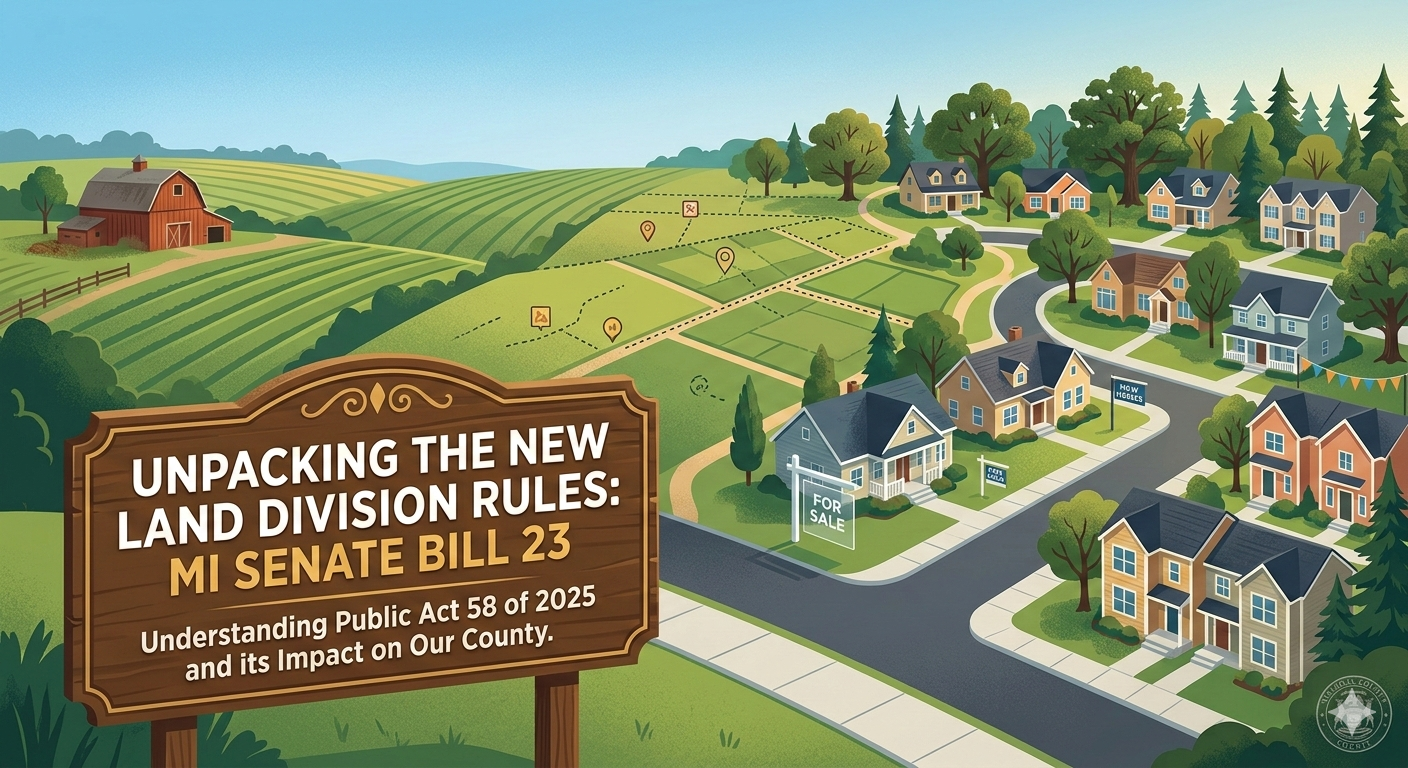
Have you ever looked at a large parcel of property and wondered, “How many smaller lots could I responsibly divide this into?” For years, the answer in Michigan was governed by strict rules designed decades ago. But that is officially changing.
Michigan Senate Bill 23, now signed into law as Public Act 58 of 2025, represents the most significant update to the Land Division Act (1967 PA 288) in many years.
This new legislation shifts how communities approach residential growth and provides more flexibility for landowners. If you own acreage, are involved in real estate, or serve on a local board, this new law is for you.
What Changed? The Rise of the “10-for-10 Rule”
The primary purpose of Public Act 58 is to make the process of dividing land more accessible and less expensive for property owners. Previously, dividing a property required an often cost-prohibitive process known as “platting” for relatively few parcels.
Here are the key shifts:
- Old Rule: The first 10 acres of a “parent parcel” could generally be divided into a maximum of 4 distinct parcels.
- New Rule (State Default): The default limit for the first 10 acres increases to 10 parcels.
In short: Michigan has effectively more than doubled the potential density for landowners who wish to create new building sites on smaller tracts of land.
This change seeks to encourage new, diversified housing stock—from smaller single-family homes to duplexes—by reducing the engineering, legal, and bureaucratic hurdles typically associated with creating residential subdivisions.
The Timeline: When Does This Start?
This is not happening overnight. The law includes a phased implementation timeline designed to give local municipalities time to prepare and adapt their own planning and zoning policies.
| Milestone | What It Means | Effective Date |
| Local Ordinance Authority | Municipalities can “opt-in” early. Townships, cities, and villages gain the legal authority to pass ordinances that allow these higher-density divisions immediately. | March 24, 2026 |
| Statewide Default Increase | This becomes the automatic state law. If a local municipality has not passed its own ordinance on the matter, the default state-level limit automatically increases to 10 parcels for the first 10 acres. | March 24, 2027 |
Local Control and Potential Concerns
This law gives substantial decision-making power to the local level. Municipalities have the opportunity to proactively manage their density. They can choose to:
- Align precisely with the new state minimums.
- Maintain stricter local standards (in specific zones where utility infrastructure or traffic safety is a priority).
- Design local “bonus” programs for developments that offer community amenities or public utility connections.
Infrastructure is the Conversation
While the new law provides density, it does not guarantee water and sewer access. An immediate point of discussion for local planning commissions will be managing infrastructure strain. As density increases from four homes to ten homes on a ten-acre site, the demand on local road maintenance and, critically, on private septic systems and wells must be managed to ensure long-term community health and water quality.
Where Can I Get More Information?
Understanding how this specific state law applies in your community requires knowing your local ordinances. This is a phased rollout, and your local government is your best resource.
- For Landowners and Real Estate Professionals:
If you are planning to divide your land after March 24, 2026, you must coordinate with your local city, village, or township zoning office. They will determine if they have passed an early opt-in ordinance or if they will wait for the statewide default to kick in in 2027. They manage the specific application process for land division. - For Planning Officials and Local Boards:
Local Planning Commissions and Township Boards should begin reviewing their current Master Plans and Zoning Ordinances now. Coordination with the County Planning Department is encouraged to ensure regional alignment and to address shared infrastructure concerns. - General Resources:
You can find the full text of Public Act 58 of 2025 (Senate Bill 23) by visiting the Michigan Legislature website and using the “Bills” or “Public Acts” search tools.