

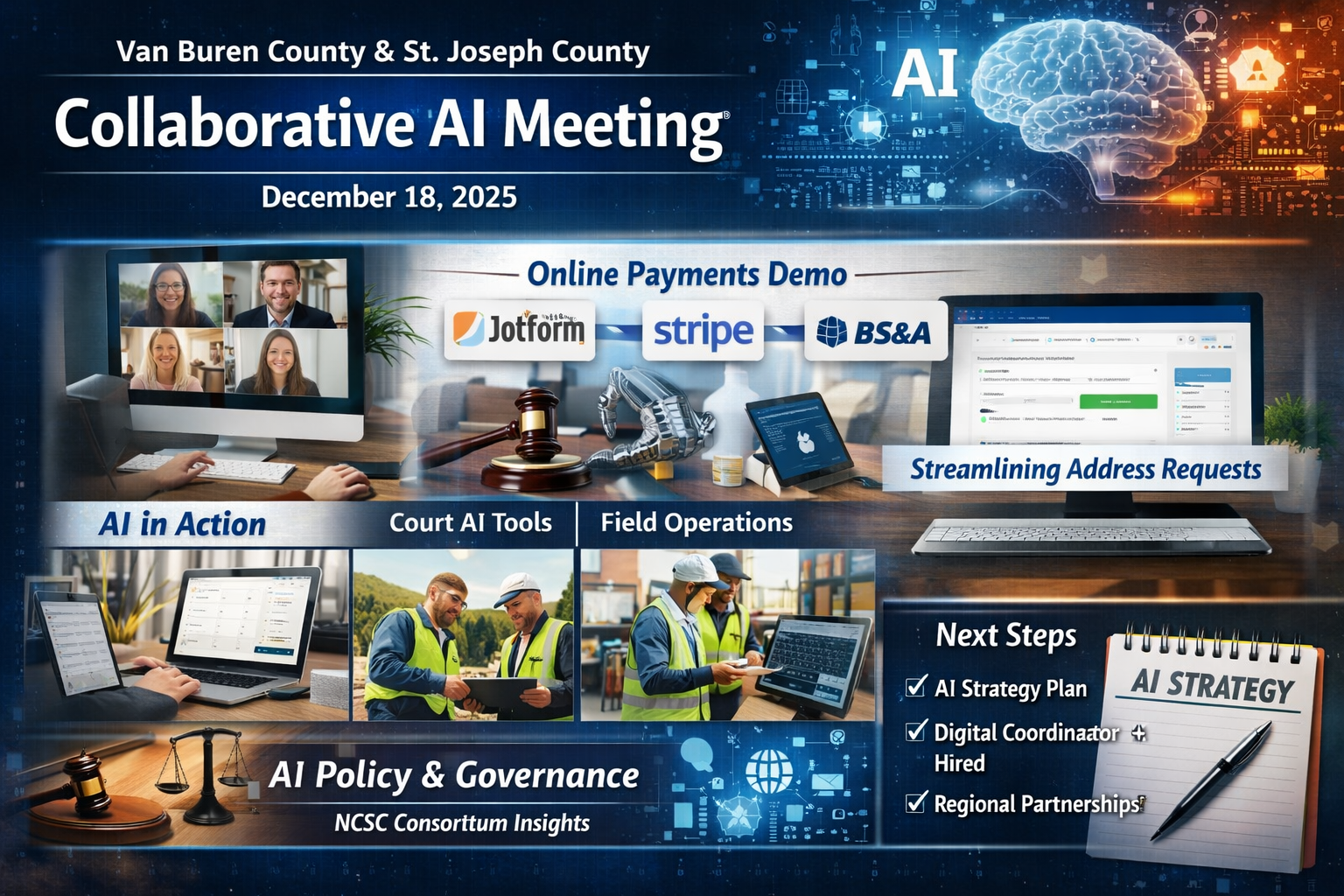
Van Buren County & St. Joseph County
December 18, 2025
Purpose and Framing
This meeting marked an intentional shift from parallel, county-specific AI discussions toward a shared, collaborative model between Van Buren County and St. Joseph County. The session served three purposes:
- Launch a new joint meeting structure to reduce duplication and improve coordination
- Build shared situational awareness of how AI is already being used across departments
- Demonstrate tangible, in-progress AI-enabled systems, not just concepts or policy discussions
The tone was practical, exploratory, and notably candid—reflecting a group that has moved beyond “AI curiosity” into early operational use.
New Meeting Structure: Fewer Meetings, More Signal
A key outcome was agreement on a new two-meeting monthly cadence:
- First meeting (Virtual, Joint):
- Second Thursday of each month at 9:00 AM
- Focus: shared technology exploration, demos, cross-county issues, and regional projects
- Second meeting (In-Person, County-Specific):
- Existing schedules remain in place
- Focus: local implementation, department-specific issues, and execution details
This change consolidates effort, reduces redundancy, and creates a standing forum for shared learning across counties
Roundtable Introductions: AI Is Already Embedded
One of the most valuable segments was a full round-robin introduction, where participants described how they are actually using AI today. Several themes emerged clearly:
1. AI as Administrative Leverage
Many departments are using AI to eliminate low-value friction:
- Generating annual schedules (public defenders, court home visits)
- Drafting and balancing employee evaluations
- Improving tone and clarity in emails and correspondence
- Reviewing contracts and policies for gaps or inconsistencies
This was not speculative use—multiple participants described hours or days saved on tasks that previously consumed disproportionate effort.
2. Courts and Justice: Opportunity with Caution
Court-related staff emphasized both promise and risk:
- AI is accelerating legal research and procedural guidance
- Strong awareness exists around hallucinated citations, unauthorized practice of law, and access-to-justice implications
- Emerging interest in AI-supported orientation videos, procedural explainers, and guided filing tools—always with a “human-in-the-loop” mindset
This balance between productivity and professional responsibility was a recurring thread.
3. Training, Operations, and the Field
Operational departments (Road Commissions, Facilities, 911) are exploring AI for:
- Standardized training videos
- Equipment competency tracking tied to pay scales
- Safer, more consistent onboarding
- RFP drafting and vendor evaluation
Notably, AI is being framed as a consistency and risk-reduction tool, not merely a speed tool.
Demonstration: Online Payments as Digital Infrastructure
The technical centerpiece of the meeting was Drake Olejniczak’s live demo of a new online payment workflow—significant not because it was flashy, but because it solved a long-standing structural problem.
What Was Shown
A complete, end-to-end process for online address requests, integrating:
- Jotform (intake and approval workflow)
- Stripe (modern payment processing with delayed capture)
- BS&A (legacy accounting system)
- Google Cloud (middleware and audit trail)
Key design decisions:
- Payments are authorized but not captured until staff approval
- Transaction fees are correctly passed through
- Every step is logged for auditability
- No reliance on expensive enterprise licenses
This was explicitly framed as a proof of concept, with dog licensing and other services already queued as next adopters
Strategic Implication
This demo illustrated a larger point:
AI and automation are increasingly about systems integration, not just chatbots. The counties are quietly building a modern digital backbone that legacy vendors struggle to match.
External Learning: Courts, Governance, and Risk
Elizabeth Clark introduced the NCSC AI Policy Consortium webinar series, highlighting it as a valuable, no-cost resource—even for non-court departments.
Key takeaways:
- Strong focus on AI readiness, governance, and risk tiering
- Practical discussion of human-in-the-loop vs. human-on-the-loop
- Real-world case studies on AI failure modes
- Role-based learning tracks (clerks, administrators, judges, etc.)
There was agreement to include a guided walkthrough of this resource at a future meeting, reinforcing the group’s emphasis on informed—not reckless—AI adoption
Organizational Updates and Forward Look
Staffing
- A Digital Communications Coordinator (Bethany Ballard) has accepted an offer and will begin early 2026
- Role focus:
- Website ownership and content coordination (both counties)
- Digital communication strategy
- Light project coordination to keep AI initiatives on track
Regional Strategy
Jerry outlined a clear capacity-building strategy:
- Partnering with regional entities (SWMPC, Market One, others)
- Using funded external projects to justify additional technical staffing
- Ensuring regional work feeds back into county capability—not distraction
What’s Next
- Development of a formal AI Strategic Integration Plan for both counties
- Short, focused timeline (weeks, not months)
- Emphasis on:
- Clear goals
- Guardrails
- Realistic ambition
- County-approved direction
Overall Assessment
This meeting demonstrated a quiet but important transition:
- From learning about AI → using AI
- From department silos → cross-county collaboration
- From tools → infrastructure
- From experimentation → intentional strategy
The most notable signal was not any single demo or use case, but the breadth of adoption already underway—and the shared recognition that the next phase requires coordination, governance, and discipline, not just enthusiasm.
The groundwork for that next phase is now clearly in place.