

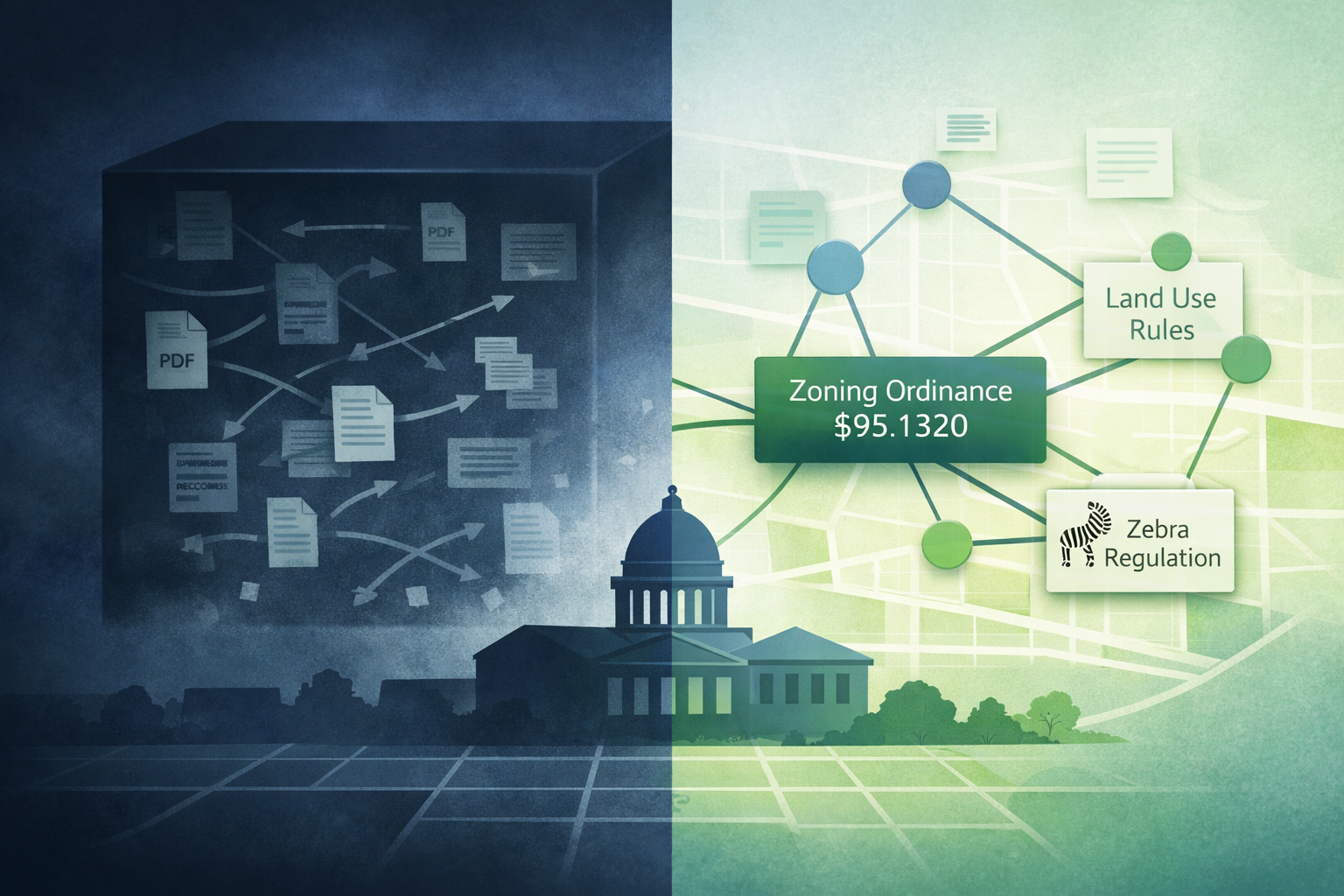
It’s not every Thursday morning that a conversation about zebra ownership leads to a breakthrough in government AI strategy, but that’s exactly what happened when Jerry demonstrated a zoning chatbot that could confidently cite Section 95.1320 to inform a curious resident that yes, they can keep one zebra on five acres in the Township (though as someone pointed out, zebras are herd animals, so that single zebra might have opinions about the arrangement).
The moment crystallized something the Digital Innovation Task Force has been working toward for months: AI that doesn’t guess.
The Black Box Problem
The meeting opened with Jerry walking through, the platform powering the county’s AI chatbots. At $120/month for the full suite, compared to the $5,000-$15,000 annual fees vendors typically charge municipalities, it’s been an excellent value. But Jerry raised a strategic concern that’s been quietly building: vendor lock-in.
Every file uploaded, every correction made, every refinement to Marty’s knowledge base deepens the county’s dependence on the vendor’s proprietary systems. The processing that makes documents AI-readable, the chunking, vectorizing, knowledge graph construction, happens in a black box the county doesn’t control.
“If the vendor suddenly ups their subscription costs, we’ve got all of our work tied into them. And we can’t easily get out.”
The more awesome Marty becomes, the more the county’s AI infrastructure belongs to someone else.
PDFs: The Worst File Format for AI
Here’s a counterintuitive truth that emerged from the discussion: PDFs, the default format for “going digital,” are actually the worst file format for AI systems.
PDFs were designed for printers, not machines trying to understand content. They’re filled with formatting code that AI has to parse through to find actual text. Tables become garbled. Cross-references between sections get lost. A zoning definition in chapter one that applies to an ordinance in chapter fifteen with an exception buried in the appendix? Good luck getting consistent answers from an AI reading that PDF.
The result: non-deterministic answers. Ask the same question twice, get two different responses. Accuracy hovers around 80%, which sounds decent until you remember that for legal questions like zoning, “usually right” isn’t good enough.
From Creative Engine to Retrieval Engine
Jerry’s presentation, titled “From Digital Services to Digital Memory,” laid out the 2026 vision: build the county’s own knowledge infrastructure.
The breakthrough, as Jerry framed it, isn’t in the AI model, it’s in the substrate. By converting unstructured PDFs into structured databases, the county can transform AI from a system that generates plausible-sounding guesses into one that retrieves authoritative answers.
The proof of concept using 2021 board meeting minutes demonstrated the difference. Feed the AI a PDF of minutes, and it struggles to connect information across the document. Feed it a structured database where resolutions, dates, vote counts, and discussion topics are properly organized, and suddenly the AI can compile accurate reports about multi-meeting topics with citations.
The Township zoning demonstration took this further. Every question got a correct answer with a source citation. And when the AI didn’t have information? Instead of fabricating something plausible, it simply said: “I don’t know, contact your zoning administrator.”
That’s the goal. AI that’s right all the time, or honest about what it doesn’t know.
Breaking Free from JotForm
Drake demonstrated a prototype that applies similar thinking to form processing. The current JotForm-based workflows hit a wall when forms need to pull in external data, like verifying a parcel actually exists in the county’s GIS system before accepting an address change request.
The new Google Cloud-native system starts with a lightweight parcel viewer. Search by name, address, or parcel number; visually verify you’ve selected the right property; then click to start the address change process with your information pre-populated. No more typos sending requests to the wrong part of the county. No more accidentally selecting your neighbor’s parcel.
On the approval side, staff get a customizable interface (something JotForm doesn’t offer) with one-time password authentication, no credentials to remember. While legacy systems like BS&A remain in use, the system exports approved changes in the right format for import. Eventually, approvals will update GIS data instantaneously.
The architecture extends to any multi-step approval process: building permits, zoning variances, land division applications. Users will track their requests like tracking a package, knowing exactly where things stand and who’s responsible for the next step.
A Quick Detour Through Google Labs
Drake also showed off Google Pomelli, a free tool from Google Labs that analyzes your website to extract brand DNA, logos, colors, fonts, taglines, then generates on-brand marketing content including social media posts with auto-generated visuals. Like NotebookLM before it, Pomelli is an experimental project that may eventually become a paid product. For now, it’s free and surprisingly capable.
What’s Next
The Digital Information Department’s 2026 focus is clear: build the knowledge layer that makes trustworthy AI possible. That means converting key county information, ordinances, minutes, resolutions, policies, from PDF blobs into structured, machine-readable formats that any AI can access accurately.
It’s infrastructure work. Not as flashy as a chatbot that knows about zebras. But it’s the foundation that makes everything else reliable.
And somewhere in there, we still need to figure out what to do about all those documents migrated from the old website that probably shouldn’t be publicly visible. But that’s a conversation for next time.