
Property Tax Mailing Address Change, Streamlined: How Automation is Saving Hours and Hassles in Van Buren County
Summary
- Van Buren County used to handle mailing address changes through phone calls, emails, and paperwork — a slow and error-prone process.
- The Digital Information Department built a new system using online forms and automation to make everything faster, easier, and more accurate.
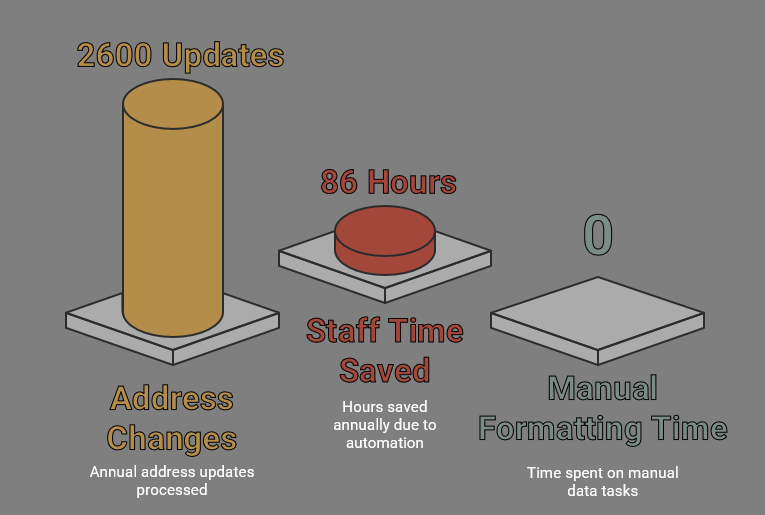
- Now, updates go through one system, saving about 86 hours of staff time every year and improving service for residents and local governments.
Revised November 13th, 2025 / Drake Olejniczak & Walter Elsner / Reading Time: 2 minutes
Updating the mailing address for a property tax bill seems like it should be easy. But for years in Van Buren County, it wasn’t.
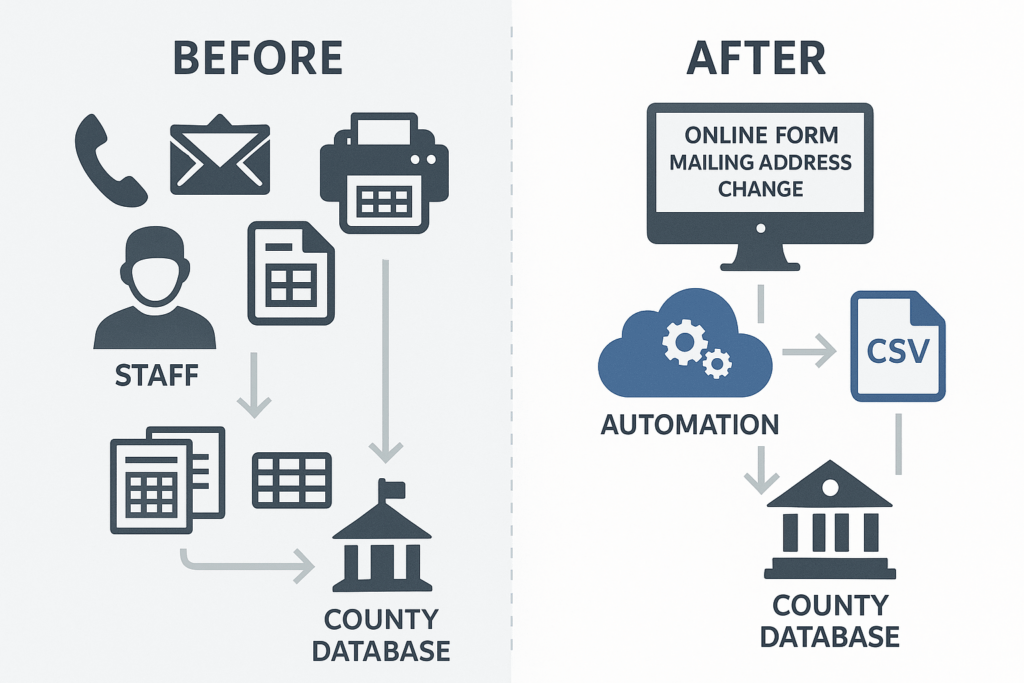
A resident would call. Or email. Or fax. A township clerk might send over a spreadsheet. Another might use a handwritten note. Some changes came directly to the County, others through one of the 29 local units, and a few… didn’t make it anywhere at all.
All of that added up to a messy, inconsistent process — and about 80-90 hours a year spent just tracking down, fixing, or re-entering mailing address changes.
So the Digital Information Department (DID) decided to fix it.
From Chaos to Clicks
The goal was simple: create one place where all mailing address changes could be submitted, reviewed, and processed — without the back-and-forth emails, missing details, or late-night spreadsheet cleanup.
The team built a digital workflow that guides taxpayers and local officials through a clean, easy online form. Submissions flow automatically into a processing queue, get routed for approval, and land in well-organized Google Sheets behind the scenes.
Every Monday, two tidy, ready-to-upload files show up in a staff inbox:
one for owner addresses, one for taxpayer addresses.
No reformatting. No deciphering handwriting. No guessing where a request came from.
Just clean data in, clean data out.
Why the Form Works the Way It Does

One thing the team had to get right was defining what the form should and should not do.
The public form’s job is to update existing mailing addresses — not to create new taxpayer records or turn on the “Send To: Owner and Taxpayer” setting when it isn’t appropriate. While the system can technically insert a taxpayer address when none exists, that record doesn’t actually do anything. It just adds clutter without triggering any mailings.
And that’s on purpose.
Deciding when a taxpayer should exist in the tax system or when mail should go to both the owner and taxpayer, is something that should happen only when there’s a legitimate ownership or billing change — like when a deed or land contract is processed. It’s not a judgment call we want to hand off to the public or to township clerks submitting everyday address updates.
To help with that, the form includes hints, safeguards, and small nudges that keep people from entering information that doesn’t belong there. Still, any system is only as accurate as what gets typed into it (“garbage in, garbage out”), so the workflow includes two layers of review before anything reaches the tax system.
And yes — ZIP codes don’t validate against the legacy tax system’s internal ZIP code library. So if someone enters a ZIP you’ve never heard of from some suburb outside of Chicago, you might not catch it. But…
A Better Way to Audit Mistakes
The old system didn’t leave much of a paper trail. A sticky note might fall off. An email might get buried. A phone message might not include the parcel number.
Not anymore.
Now, every submission comes with a built-in breadcrumb trail: timestamps, device information, and other details of whoever submitted the request. If a taxpayer calls upset about a misrouted bill, staff can see exactly what happened and when.
It’s better for accuracy — and better for accountability.
By the Numbers
Built for Today, Ready for Tomorrow
The address change workflow wasn’t built as a one-off fix. It’s a blueprint. The same model can support name changes, permit tracking, or other routine submissions across the County.
And because everything — from the form to the code to the backups — was intentionally documented, the process can be rebuilt at any point. That’s future-proofing done right.
What’s Next?
The DID is already planning a few helpful upgrades, like smarter notifications when a single request involves parcels across multiple municipalities.
But the biggest improvement is already here: a faster, cleaner, easier way for everyone to handle mailing address changes.
A small fix with a big impact — exactly the kind of behind-the-scenes improvement that keeps county services running smoothly.